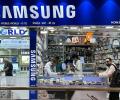
As many as 37 per cent of smartphones sold in India in 2022 cost Rs 15,000 or more.

This year's list includes 40 influential people under 40 years of age in five categories -- finance, technology, healthcare, government and politics, and media and entertainment.

The move, however, is unlikely to prompt its rivals in India - Chinese manufacturers like Oppo, Vivo, and Xiaomi - to do the same.

Foxconn means serious business in India. Its delegation to India was led by its Chairman Young Liu who met Prime Minister Narendra Modi.

At Rs 8,999 Micromax's 4G phone is pitched against the likes of Xiaomi, OnePlus and Oppo. But will it steal the limelight from these budget-smartphone worthies?

Xiaomi topped the chart as the most sold smartphone brand by its users with 26 per cent share, followed by Apple (20 per cent), Samsung (16 per cent), Vivo, and Motorola (6 per cent each) among others, it said. Most smartphones sold by users were in the sub-Rs 10,000 brackets, it added. Among models, the iPhone 7 was the hottest selling model along with some other models as well as Redmi Note 4 and OnePlus 6 during the year. The number of smartphone repairs was the highest in Delhi in 2020.

Similar discounts compared to online led to a spike in demand for offline, where customers can get a more personal and hands-on product experience.

The Moto G4 Plus is a worthy consideration under the Rs 15,000 budget, but users looking for a better build quality and more processing power will do well to opt for either Xiaomi Redmi Note 3, or even the ZUK Z1, says Himanshu Juneja

Chinese mobile brands are deeply entrenched in the Indian market. A move to bar them may send a bold diplomatic message. But its cost for the local industry is anybody's guess. In the event that Chinese brands face curbs, two handset makers - Samsung and Apple - squarely stand to gain.

In a boost to the electric vehicle boom in India, Taiwanese major Hon Hai Technology Group (aka Foxconn) is likely to set up an EV manufacturing unit in India through its subsidiary Foxtron. Amid speculation that the company may look at Tamil Nadu and probably the Ford India unit near Chennai for its new facility, sources indicate that the group was already betting big in the electric vehicle component space in India through Bharat FIH, which is already having a tie up with companies like Ola Electric and Ather. Bharat FIH currently has two manufacturing units in Tamil Nadu's Sriperumbudur that manufactures phones like Apple iPhones and Xiaomi phones.
Smart devices maker Samsung continued to lead the smartphone market in the country for the fourth consecutive quarter in July-September with a 17.2 per cent market share, market research firm Counterpoint said on Wednesday. Shipments of iPhone maker Apple crossed 2.5 million units in the reported quarter thereby registering an all-time high in a quarter, according to the Counterpoint's Monthly India Smartphone Tracker report. "Samsung maintained its leading position for the fourth consecutive quarter with a 17.2 per cent share driven by the success of its A and M series.

After six weeks into the second half, the faltering offline channel, which traditionally rakes in 60 per cent of sales for the market, has become the biggest hurdle towards the path of revival.

Walmart-owned digital payments firm PhonePe has decided to halt its proposed acquisition of Goldman Sachs- and Xiaomi-backed ZestMoney, a Bengaluru-based buy now, pay later (BNPL) platform. The deal, which was poised to fetch anywhere between $150-200 million and $300 million, has hit a snag over lapses in due diligence, disagreements over valuation, sustainability of the business, and shareholding structure of ZestMoney, according to people familiar with the matter. The collapse of the deal is also being attributed to a slowdown in the financial technology (fintech) sector in the midst of a funding winter, difficult regulatory environment, and macroeconomic uncertainty, informed other sources.

Home-grown companies, including electronics manufacturing services (EMS) firm Dixon Technologies and mobile device maker Lava International, have started exploratory talks with Chinese sub-assemblies and component players for setting up joint ventures (JVs) in the country. Sources in the industry say many domestic companies have also had preliminary discussions with original design manufacturers (ODMs) in China to look at a JV model for manufacturing smartphones. Key ODM players in mobile devices in China include Longcheer, Huaqin, and Wingtech, which has already set up a plant in Tirupati.
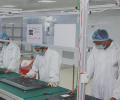
Dixon Technologies right now is a beehive of activity. It is building a new facility in Noida to make 1.3 million laptops for Taiwanese PC maker Acer. The facility must be up and running in four months. The pace of activity will only increase. Last week Dixon won a similar contract from Lenovo, the Chinese personal computer maker and the third largest information technology (IT) hardware brand in India, to assemble laptops and notebooks. Though the clientele in these two cases is Taiwanese and Chinese, Dixon is a company reaching for the stars with its feet planted firmly in the Indian government's policy.

As 4G internet completes coverage of the entire country, rural markets have become the primary generator of sales.

Oppo is the second Chinese brand after Xiaomi to secure single-brand retail licence. Xiaomi has now 600 retail partners.
Streamlining its delivery network and shifting focus back to the mass segment - at a time when competitors were struggling to restore normalcy in operations due to the pandemi - aided the firm's revival.

Smartphone shipment in India declined by 10 per cent to hit a three-year low of 43 million shipment in the July-September 2022 period, market research firm International Data Corporation said on Monday. The 5G smartphone share reached 36 per cent of total smartphones during the reported quarter with 16 million units at a slightly higher average selling price of $393, about Rs 32,000, apiece compared to $377, about Rs 30,600, in the previous quarter. "India smartphone market declined 10 per cent year-over-year (YoY) shipping 43 million units in July-September 2022.

'We welcome India's ban on certain mobile apps that serves as an appendage of the CCP's surveillance State'

A number of smartphone players such as Xiaomi, Samsung, LG and Micromax also have smart TVs in their product portfolio.

A pan-India 'fraud-to-phone' network has been busted by security agencies, which have also arrested eight people and seized nearly 300 new mobile phones bought with stolen funds, officials said on Tuesday. Moreover, 900 mobile phones, 1,000 bank accounts and hundreds of unified payment interface (UPI) and e-commerce IDs of this gang have been identified and are under investigation. Nearly 100 bank accounts, and debit and credit cards have been frozen by the security agencies so far, officials said.

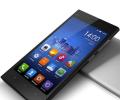
Here's why the Xiaomi Mi3 is not just another made-in-China smartphone.
They are both electronic manufacturing services (EMS) companies, also known as contract manufacturers. One is Taiwan's Foxconn group, the undisputed global number one in this business with revenues of $223 billion. The other is Dixon Technologies, the biggest domestic player with revenues of over Rs 10,500 crore.

Google, in its latest appeal to the Supreme Court, has said the Competition Commission of India (CCI) is protecting Amazon's interests after having complained that India's anti-competition body (CCI) had copied part of a European Commission ruling against it for allegedly abusing the market dominance of Android. The latest twist to the Google-CCI case comes as Google filed an appeal in the Supreme Court on June 26, against the National Company Law Appellate Tribunal's (NCLAT's) March 29 order. The tech giant's contention is that the NCLAT failed to apply the "effect analysis" part in the CCI order.

India is the world's third-largest smartphone market.

Has Asus cooked the right recipe to dethrone Xiaomi Redmi Note 5 Pro as India's best selling budget phone?

Experts say launches would pick up pace from mid-March.
The industry is keeping a close watch to see if shuttered factories in China reopen in the coming days and supplies resume sometime this week.

Lenovo, Xiaomi, Vivo, Gionee lead the onslaught, beating Indian and global brands with smart deals and astute image management measures.

A successor to Mi 4, the 'i' in 4i reflects Xiaomi's focus on India even as the Chinese company is losing ground to Apple on home turf.

'We are offering one year of free music and three months of free movies to a million users through MIUI8.'

The steep rise in prices of key components, coupled with a ban on the import of finished sets, is expected to hit prominent Chinese brands, such as OnePlus, Xiaomi, TCL, and Realme.

'Last year we sold 18 million phones in India, this year we should do 23-24 million, and next year our target is to hit 40 million.'

Industry estimates suggest that the extent of value addition in the handset space remains at a mere 10 per cent. That effectively means, value-wise 90 per cent of all components used in making a handset continues to be imported.

Bharti Airtel on Thursday said its 5G services have gone live in eight cities of Delhi, Mumbai, Chennai, Bengaluru, Hyderabad, Siliguri, Nagpur and Varanasi. The customer availing 5G services will have to pay as per their existing 4G plan, it said. "Airtel has been at the forefront of India's telecom revolution for the last 27 years.
It was expected that supplies from China will be back to normal by end-June as their factories are now operating at nearly 90 per cent of normal capacity. But the recent issue with shipments has placed an obstacle that manufacturers can't bypass.

Shipment of 5G smartphones in the country continues to gain traction and such devices accounted for 22 per cent market share in the third quarter of 2021, according to CMR. As per CMR's India Mobile Handset Market Review Report for Q3 2021, more than 20 5G-capable smartphones were launched over the course of the quarter.

The Canadian smartphone maker is banking on its platform-agnostic security and software products to make incursions in the market.

Microsoft has launched its first 4G device, the Nokia Lumia 638 with Windows Phone 8.1 at a price of Rs 8,299.
